How OpenAI's GPT-5.5 and NVIDIA's Infrastructure Are Transforming AI Development
AI agents are reshaping how developers and knowledge workers tackle complex tasks. OpenAI's latest model, GPT-5.5, now powers the agentic coding application Codex, running on NVIDIA's GB200 NVL72 rack-scale systems. This combination is delivering dramatic efficiency gains—slashing debugging cycles from days to hours and enabling teams to ship features from natural-language prompts with unprecedented reliability. With over 10,000 NVIDIA employees across departments already using Codex, the integration marks a milestone in making frontier-model inference viable at enterprise scale. Below, we explore key questions about this breakthrough partnership.
What is Codex and how does GPT-5.5 enhance it?
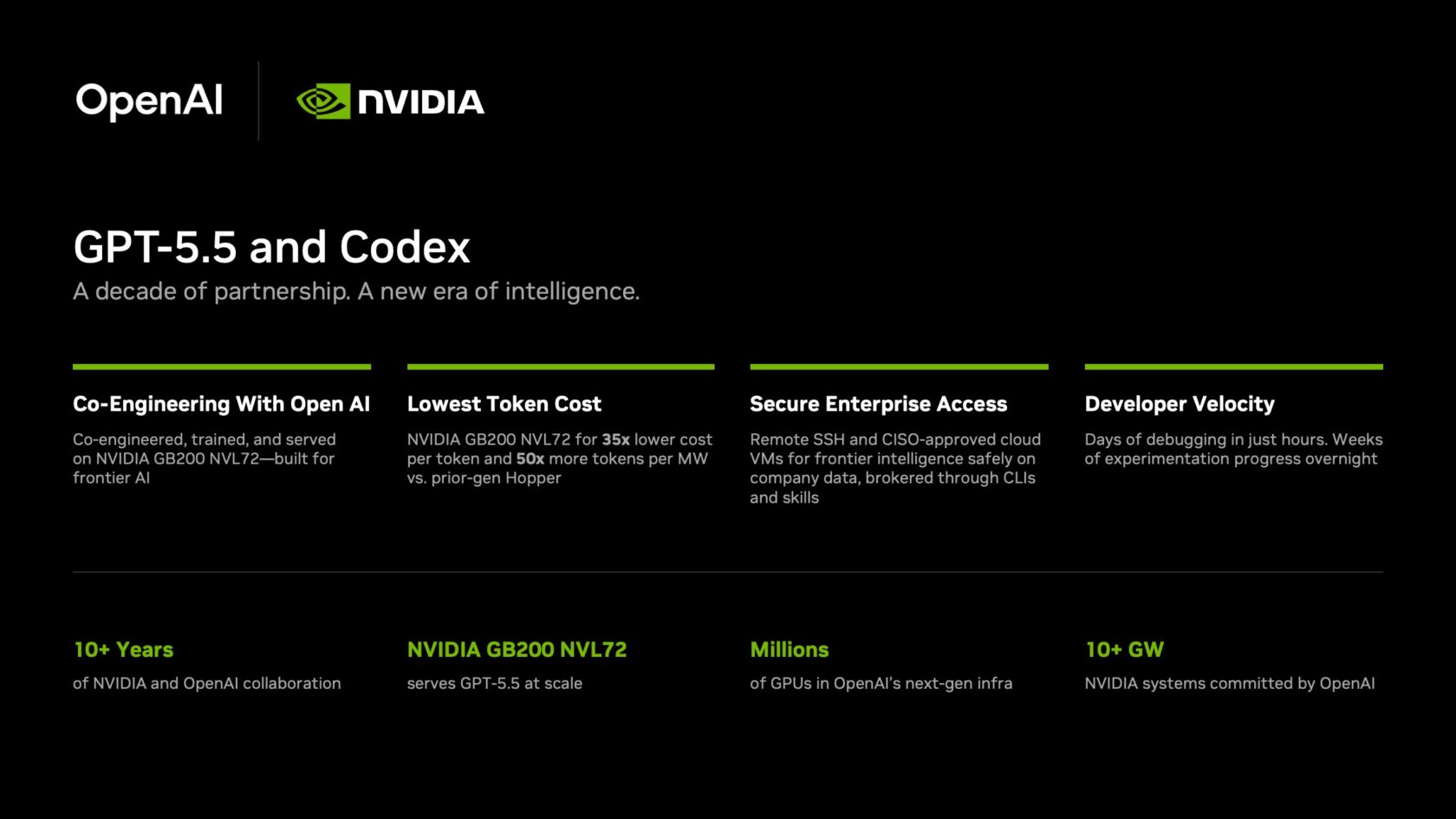
Codex is OpenAI's agentic coding application designed to automate software development tasks. It leverages AI to process information, solve complex problems, and generate code. With the integration of GPT-5.5, OpenAI's latest frontier model, Codex gains significantly improved reasoning, reliability, and efficiency. GPT-5.5 is optimized for multi-file codebases and can handle end-to-end feature generation from natural-language prompts. Running on NVIDIA's GB200 NVL72 infrastructure, GPT-5.5 delivers up to 50x higher token output per second per megawatt and 35x lower cost per million tokens compared to prior-generation systems. This makes it economically feasible for enterprises to deploy agentic AI at scale, enabling faster experimentation and shorter development cycles.
How is NVIDIA using GPT-5.5-powered Codex internally?
NVIDIA has rolled out Codex to over 10,000 employees across departments including engineering, product, legal, marketing, finance, sales, HR, operations, and developer programs. These “NVIDIANs” report “mind-blowing” and “life-changing” results. Engineers have used Codex for a few weeks and already see measurable gains: debugging cycles that previously spanned days now close in hours, and experimentation that required weeks is turned into overnight progress. Teams can ship end-to-end features from natural-language prompts with stronger reliability and fewer wasted cycles. The company's CEO, Jensen Huang, urged all employees in an email to “jump to lightspeed,” emphasizing the transformative potential of AI agents.
What performance gains does the GB200 NVL72 infrastructure provide?
The GB200 NVL72 rack-scale system is central to Codex's performance. It delivers 35x lower cost per million tokens and 50x higher token output per second per megawatt compared to earlier systems. These economics make frontier-model inference viable at enterprise scale. For example, debugging cycles that once took days are now completed in hours. Experimentation that required weeks can be accomplished overnight, even in complex, multi-file codebases. Teams also report stronger reliability and fewer wasted cycles than with earlier models. This infrastructure allows NVIDIA to run GPT-5.5 efficiently, reducing energy consumption while maximizing output.
How does NVIDIA ensure enterprise security with Codex?
Security is a top priority. Codex supports remote Secure Shell (SSH) connections to approved cloud virtual machines (VMs), ensuring agents work with real company data without exposing it externally. NVIDIA IT rolled out cloud VMs for every employee, creating a dedicated sandbox with full auditability. Users control the Codex agent from a familiar interface, while a zero-data retention policy governs the deployment. Agents access production systems with read-only permissions through command-line interfaces and the same agentic toolkit (Skills) that NVIDIA uses for automation workflows. This setup balances maximum agent capabilities with enterprise-grade security.
What is the history of collaboration between NVIDIA and OpenAI?
The partnership between NVIDIA and OpenAI spans more than a decade, beginning in 2016 when Jensen Huang personally handed over the first NVIDIA DGX-1 system to a then-nascent OpenAI. This full-stack collaboration has deepened over the years, with NVIDIA providing not only hardware but also software optimizations and infrastructure expertise. The GPT-5.5 launch and Codex rollout are the latest fruits of this relationship. NVIDIA works with every frontier model company to accelerate AI agents internally and help partners build the best, lowest-cost, and most power-efficient models. The GB200 NVL72 system, co-developed with OpenAI's feedback, exemplifies how joint innovation drives progress.
What does Jensen Huang's “jump to lightspeed” message signify?
In a company-wide email, NVIDIA CEO Jensen Huang urged all employees to use Codex, saying: “Let's jump to lightspeed. Welcome to the age of AI.” This rallying cry underscores the urgency and transformative potential of AI agents. Huang sees Codex not as a minor tool but as a paradigm shift in how work gets done—moving from manual, time-consuming debugging and experimentation to AI-driven, near-instant code generation and problem-solving. The message reflects NVIDIA's commitment to integrating AI at every level, from engineering to operations, and signals that the company expects similar leaps from its partners. The “lightspeed” metaphor captures the dramatic acceleration in development cycles that GPT-5.5 and Codex enable.