Mastering List Flattening in Python: A Step-by-Step Guide
Introduction
Working with nested data structures is a daily reality for many Python developers. Lists within lists—also known as multidimensional lists—are common when dealing with matrices, grouped data from APIs, or nested outputs from functions. Flattening such structures into a simple one-dimensional list makes data manipulation, analysis, and iteration far easier. This guide will walk you through the process step by step, from understanding the problem to implementing efficient, Pythonic solutions.
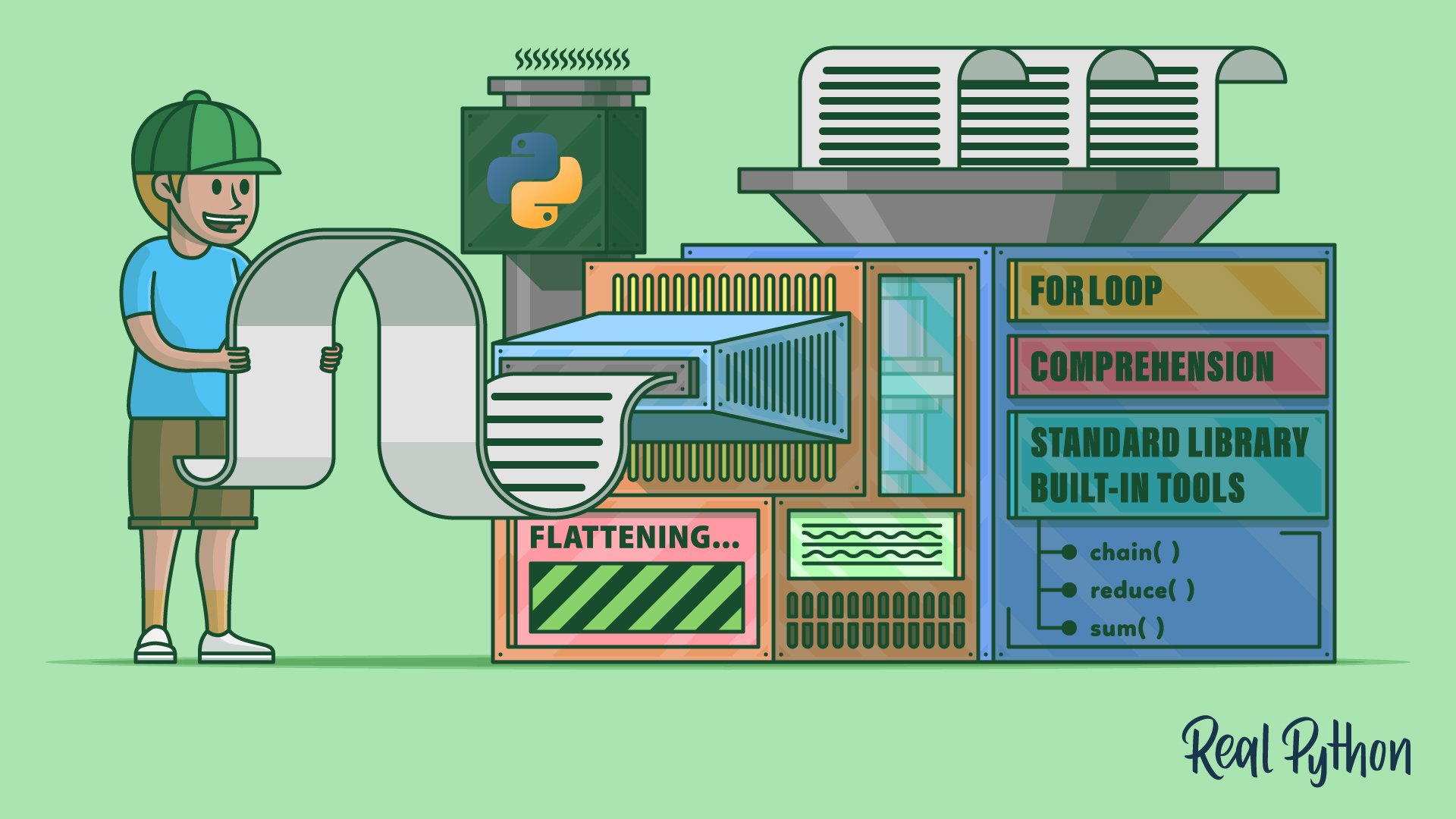
Whether you're a beginner or an experienced coder, this guide provides practical techniques, best practices, and pro tips to flatten lists of any depth. By the end, you'll be able to choose the right approach for your specific use case.
What You Need
- Python 3.6 or later (some methods use features from 3.3+, but 3.8+ is recommended)
- A basic understanding of Python lists, loops, and list comprehensions
- A Python environment (local interpreter, Jupyter notebook, or an online REPL like Replit)
- Optional:
itertoolsfor advanced flattening (part of the standard library)
Step-by-Step Guide to Flattening Lists
Step 1: Identify Your Data Structure
Before writing any code, examine the list you want to flatten. Is it a simple nested list with a single level of nesting (like [[1, 2], [3, 4]]) or deeply nested with varying depths (like [[1, [2, 3]], [4]])? The approach differs based on depth and regularity.
- Regular nesting: All sublists are at the same depth.
- Irregular nesting: Sublists can be nested arbitrarily.
- Mixed types: Some elements may be non‑iterable (e.g., integers, strings).
Knowing this helps you choose the right tool from the start.
Step 2: Use a Simple Loop for One Level of Nesting
If your list contains only sublists at the first level (e.g., a matrix), the most straightforward method is a nested for loop:
matrix = [[1, 2], [3, 4], [5, 6]]
flattened = []
for row in matrix:
    for item in row:
        flattened.append(item)
print(flattened)  # Output: [1, 2, 3, 4, 5, 6]
This is easy to read and understand. However, for processing large data, list comprehension is more concise.
Step 3: Embrace List Comprehension for Concise Code
Python’s list comprehension is both fast and readable. The same flattening can be written in one line:
matrix = [[1, 2], [3, 4], [5, 6]]
flattened = [item for sublist in matrix for item in sublist]
print(flattened)  # [1, 2, 3, 4, 5, 6]
The order of for clauses mirrors the nested loop above. This method works only for one level of nesting. For deeper structures, we need recursion.
Step 4: Flatten Arbitrary Depth with Recursion
When sublists are nested to unknown depths, write a recursive function that checks each element:
def flatten_deep(nested_list):
    result = []
    for item in nested_list:
        if isinstance(item, list):
            result.extend(flatten_deep(item))
        else:
            result.append(item)
    return result


deep_list = [[1, [2, 3]], [4, [5, [6, 7]]]]
print(flatten_deep(deep_list))  # [1, 2, 3, 4, 5, 6, 7]
This approach handles any depth but can be slow for extremely deep recursion (Python’s recursion limit is ~1000). For production code, consider iterative solutions (see Step 6).
Step 5: Leverage itertools.chain for Single‑Level Flattening
The itertools module provides a fast, memory‑efficient way to flatten one level:
from itertools import chain

matrix = [[1, 2], [3, 4]]
flattened = list(chain.from_iterable(matrix))
print(flattened)  # [1, 2, 3, 4]
chain.from_iterable takes an iterable of iterables and yields each element. Wrapping list() materializes it. This is often the fastest pure‑Python method for two‑dimensional lists.
Step 6: Use collections.deque for Deep Iterative Flattening (Advanced)
For deep nesting without recursion limits, iterate using a stack with collections.deque:
from collections import deque

def flatten_iterative(nested_list):
    result = []
    stack = deque(nested_list)
    while stack:
        item = stack.popleft()
        if isinstance(item, list):
            # Extend left to maintain order (or reverse the sublist first)
            stack.extendleft(reversed(item))
        else:
            result.append(item)
    return result


deep = [1, [2, [3, 4]]]
print(flatten_iterative(deep))  # [1, 2, 3, 4]
The key is using extendleft with reversed sublists to preserve original order. This method avoids recursion depth issues and is suitable for large irregular data.
Step 7: Test Edge Cases
Always test your flattening function with:
- An empty list:
[]should return[]. - A flat list:
[1, 2, 3]should be unchanged. - Mixed types (if needed):
[1, ['a', 2], 3]– decide whether to treat strings as atomic or iterable. - Very deep nesting: ensure your method handles it efficiently.
Write small unit tests or assertions to verify correctness.
Tips and Best Practices
- Know your data: If the nesting is shallow, simple loops or list comprehensions are best. For deep or irregular nesting, recursion or iterative stacks are better.
- Avoid
evalorexec: Never use string manipulation to flatten lists—it’s slow, dangerous, and non‑Pythonic. - Consider performance: For millions of items,
itertools.chainis highly optimized. For deep nesting, the iterative deque method has O(n) time and space. - Use generator versions for memory efficiency: Replace
listwithyield fromin recursion or modify the deque approach to yield instead of appending. - Document your assumptions: If you treat strings as scalars (rather than character lists), add comments so future readers understand the behavior.
- Learn from the community: The recursive approach and
itertools.chainare widely accepted. Bookmark Python’s official documentation foritertools. - Practice with real data: Try flattening JSON responses or API results that come as lists of lists to solidify the techniques.
Flattening lists is a fundamental skill that appears again and again in data processing. By mastering these steps, you’ll write cleaner, faster, and more maintainable Python code. Happy coding!